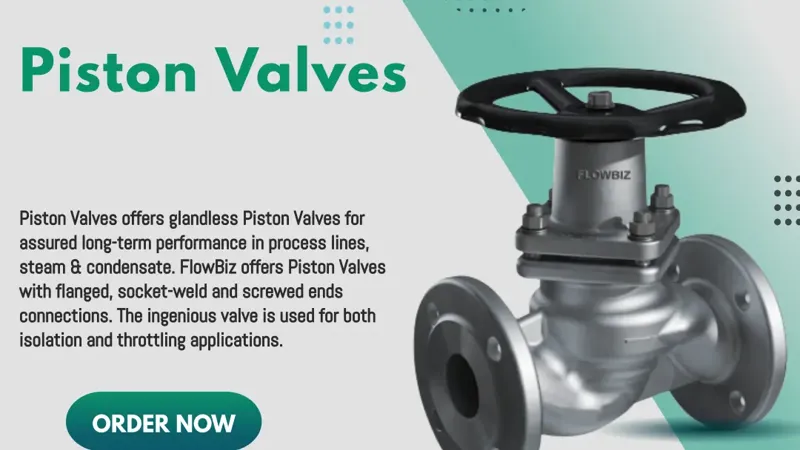
Types of Piston Valves: Design & Functionality
Piston valves operate using a cylindrical piston and two resilient seal rings. Unlike other valves, the seal is created by the constant contact between the piston and the inner surface of the rings, rather than a disc hitting a seat.
1. Standard (Normal) Type
This is the primary design used for on/off isolation or "block" service. The piston is a straight cylinder that moves through the sealing rings to fully shut off or fully open the flow path.
- Sealing: Provides a large surface area for sealing, ensuring bubble-tight shut-off.
- Best for: Steam isolation, condensate lines, and process fluids.
2. Regulating (Throttling) Type
In the regulating style, the lower portion of the piston is tapered. This modification allows for precise control over the flow rate as the valve is opened.
- Throttling Effect: The tapered shape ensures that the flow area increases gradually, preventing the "hunting" effect in control systems.
- Best for: Fine flow adjustment and pressure regulation.
Pressure Balancing: The Operational Choice
When selecting a piston valve, the decision between balanced and unbalanced designs is dictated by the system pressure and the ease of operation required.
1. Unbalanced Piston Valves
Used primarily for low-pressure service. In this design, the upstream pressure acts directly against the top or bottom of the piston.
- Operation: At higher pressures, the force required to move the piston increases significantly, which is why these are limited to smaller sizes or lower pressure classes.
2. Balanced Piston Valves
Engineered for high-pressure benefits. These valves feature an internal bypass or a "balanced" stem design that allows the pressure to equalize on both sides of the piston.
- Advantage: By neutralizing the pressure differential, the torque required to operate the valve is drastically reduced, allowing for easier manual or automated operation in high-pressure steam headers.
Technical Specifications (FlowBiz 2026 Range)
Feature | Details |
Body Material | Cast Steel (WCB), Forged Steel (A105), Stainless Steel |
Piston Material | Stainless Steel (Hardened) |
Sealing Rings | Graphite / PTFE (Teflon) based |
Design Standard | ASME B16.34 |
Pressure Class | Class 150#, 300#, 800# |
End Connections | Flanged, Screwed, or Socket Weld |
Why FlowBiz Piston Valves?
- Glandless Design: No packing glands means no fugitive emissions, making them ideal for hazardous chemicals and high-pressure steam.
- Self-Cleaning: As the piston moves through the rings, it wipes away any scale or debris, ensuring a clean seal every time.
- Durability: The sealing rings are easily replaceable, extending the life of the valve body indefinitely.
FlowBiz Exports serves critical industrial sectors in Mumbai, Ahmedabad, Vapi, and Nashik, as well as international markets in Dubai and Africa. We provide IBR-certified solutions that meet the rigorous safety standards of the 2026 energy sector.
Does your system experience frequent leaks with standard globe valves during thermal cycling?
Upgrade to the FlowBiz Piston Valve for a maintenance-free, glandless solution. Contact our technical team today at +91 9016 989898 to determine if a balanced or regulating design is best for your specific pressure profile.
#PistonValve #FlowControl #IndustrialValves #SteamControl #EngineeringExcellence #ManufacturingIndia #FlowBizExports #ValveDesign