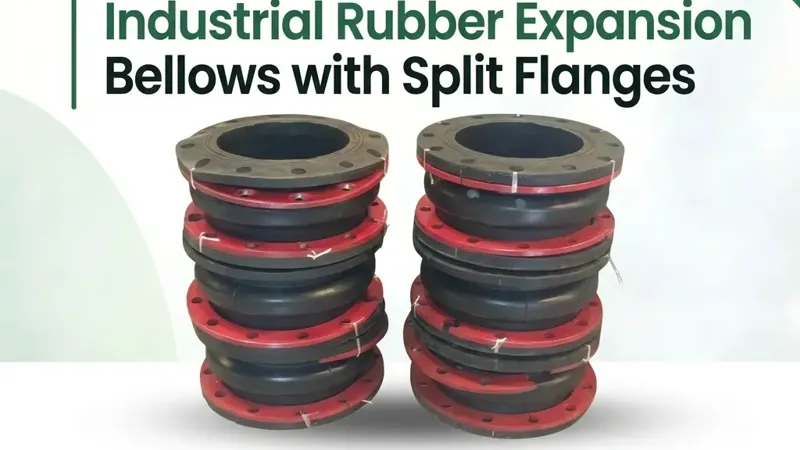
Industrial Rubber Expansion Bellows with Split Flanges Manufacturer & Exporter in India | FlowBiz Exports
Introduction to Industrial Rubber Expansion Bellows with Split Flanges
Industrial piping systems experience vibration, thermal expansion, contraction and movement during normal operation. If these movements are not properly accommodated, they can place additional stress on pipes, flanges, pumps and connected equipment.
Industrial Rubber Expansion Bellows with Split Flanges are flexible pipeline components designed to absorb selected movements and help reduce the transmission of vibration and noise. Their flexible rubber body is combined with reinforcement materials and metal split flanges or retaining rings to create a suitable connection between pipeline sections.
FlowBiz Exports provides industrial product supply solutions for customers looking for dependable piping and flow-control components. The product shown in the image features a black rubber bellows body with red split flanges, making it suitable to introduce the product category to industrial buyers.
If you are searching for Industrial Rubber Expansion Bellows with Split Flanges in India, this guide explains their construction, working principle, material options, applications, advantages and selection criteria.
What Are Rubber Expansion Bellows with Split Flanges?
Rubber Expansion Bellows, also known as Rubber Expansion Joints, are flexible connectors installed between pipeline components. Their elastomeric body can deform within its designed movement limits to accommodate selected axial, lateral and angular movements.
Split flanges, also called split retaining or backing flanges in some designs, help secure the rubber flange against the mating pipe flange. Their design allows the metal retaining components to be assembled around the rubber joint where specified by the manufacturer.
Depending on the design, a rubber expansion joint may include:
Rubber bellows body: The flexible section that accommodates movement.
Reinforcement layers: Fabric cords, steel reinforcement or other specified materials that support the rubber body.
Split flanges or retaining rings: Metal components used to support and secure the joint at the pipeline connection.
Inner rubber tube: The surface that contacts the conveyed fluid.
Outer rubber cover: A protective layer that helps protect the reinforcement from external conditions.
The exact construction depends on the joint design, size, working pressure, temperature and process fluid.
Key Features of Industrial Rubber Expansion Bellows
1. Flexible Rubber Construction
The rubber body allows controlled movement within the limits specified for the product. This flexibility can help accommodate movement that would otherwise place additional stress on rigid piping connections.
2. Split Flange Design
Split flanges or retaining rings support the joint at the pipe connection. The correct flange dimensions, drilling pattern and installation arrangement must match the intended pipeline connection.
3. Vibration Absorption
Rubber expansion joints can help reduce vibration transmission from pumps, compressors and other rotating equipment into connected pipework.
4. Noise Reduction
The flexible construction may reduce structure-borne noise transmitted through piping, depending on the equipment, installation and operating conditions.
5. Movement Compensation
Depending on the selected design, rubber expansion bellows can accommodate axial compression or extension, lateral movement and angular deflection within specified limits.
6. Reinforced Construction
Fabric and other reinforcement materials help the rubber body withstand the required operating conditions. Reinforcement selection is important for pressure resistance, movement capability and service life.
7. Multiple Material Options
Rubber compounds such as EPDM, NBR and Neoprene may be available for different service conditions. The correct material must be selected based on fluid compatibility, temperature and pressure.
Technical Specifications of Industrial Rubber Expansion Bellows with Split Flanges
| Parameter | Specification |
|---|---|
| Product Name | Industrial Rubber Expansion Bellows with Split Flanges |
| Product Type | Rubber Expansion Joint |
| Body Construction | Flexible Rubber Body |
| End Connection | Flanged Type |
| Flange Design | Split Flanges |
| Main Function | Absorption of Pipeline Movement and Vibration |
| Movement Type | Axial, Lateral and Angular Movement |
| Construction | Rubber Bellows with Reinforcement |
| Installation | Between Pipeline Flange Connections |
| Primary Application | Industrial Piping Systems |
| Other Applications | Pumps, Water Treatment Plants, HVAC and Industrial Utilities |
| Key Benefits | Vibration Reduction, Noise Reduction and Movement Accommodation |
| Material Selection | Based on Fluid Compatibility and Operating Conditions |
| Operating Pressure | Depends on Joint Construction and Size |
| Operating Temperature | Depends on Rubber Compound |
Working Principle of Rubber Expansion Bellows
Rubber expansion bellows work by allowing their flexible body to deform as the connected piping system moves.
Step 1: Installation Between Pipe Connections
The expansion joint is installed between compatible pipeline flanges according to the manufacturer's instructions.
Step 2: Movement in the Pipeline
Temperature changes, vibration or equipment movement can cause small changes in the relative position of the connected pipes.
Step 3: Flexible Body Responds
The rubber bellows compresses, extends or deflects within its rated movement limits to accommodate the permitted movement.
Step 4: Stress and Vibration Management
The joint can help reduce the transfer of some vibration and movement-related loads to connected equipment and pipework.
The expansion joint is not a substitute for correct pipe supports, guides and anchors. At operating pressure, rubber expansion joints can generate significant pressure thrust, so the piping system must be designed to manage the resulting forces. Control units or limit rods may be required for certain applications.
Types of Rubber Expansion Bellows
1. Single-Arch Rubber Expansion Joint
A single-arch design has one flexible convolution. It is used where the required movement can be accommodated within the design limits of a single arch.
2. Double-Arch Rubber Expansion Joint
A double-arch design provides two convolutions and may accommodate greater movement than a comparable single-arch design, subject to the manufacturer's ratings.
3. Multiple-Arch Rubber Expansion Joint
Multiple-arch designs are considered for applications that require additional movement capability. Their selection must account for pressure, stability and installation conditions.
4. Rubber Expansion Joint with Split Retaining Flanges
This arrangement uses split metal retaining or backing rings to secure the rubber flange against the mating pipeline flange. It is important to confirm the joint's exact flange arrangement before ordering.
5. Reinforced Rubber Expansion Joint
Reinforcement layers help the joint withstand specified pressure and movement conditions. The reinforcement type and construction are selected according to the application.
Common Rubber Materials and Their Applications
Choosing the right rubber compound is essential for safe and reliable operation.
EPDM Rubber Expansion Bellows
EPDM is commonly used in suitable water, hot-water and selected chemical services. It generally offers good weather and ozone resistance, but it is not suitable for every oil or hydrocarbon application.
NBR Rubber Expansion Bellows
NBR, also known as nitrile rubber, is often considered for applications involving oils and certain petroleum-based fluids. Its suitability depends on the specific fluid, temperature and compound formulation.
Neoprene Rubber Expansion Bellows
Neoprene can provide useful resistance to weathering and selected oils and chemicals. The actual suitability depends on the compound and operating environment.
Natural Rubber and Other Compounds
Other elastomers may be available for applications requiring particular flexibility, abrasion resistance or chemical compatibility.
Selection tip: Always confirm compatibility with the actual process fluid, its concentration, temperature and pressure. The rubber compound should not be selected by colour alone.
Applications of Industrial Rubber Expansion Bellows
1. Pump Suction and Discharge Lines
Rubber expansion joints are commonly considered for suitable pump connections to help manage vibration and movement. Correct pipe supports and pressure-thrust management remain essential.
2. Water Treatment Plants
They may be used in compatible water-treatment and utility pipelines where flexibility and vibration management are required.
3. HVAC and Cooling Systems
Rubber expansion joints can be installed in suitable chilled-water, cooling-water and HVAC piping systems to help accommodate movement and reduce vibration transmission.
4. Effluent and Sewage Treatment Plants
Suitable rubber compounds may be used in compatible wastewater and effluent services. Abrasion, chemical exposure and solids content should be considered during selection.
5. Industrial Process Pipelines
Manufacturing facilities may use rubber expansion bellows in utility and process lines where the joint material and operating ratings are appropriate.
6. Power Plants
Selected cooling-water, utility and equipment connection systems may use rubber expansion joints to manage vibration and movement.
7. Chemical and Petrochemical Industries
These applications require careful selection of the rubber compound, reinforcement and flange materials according to the fluid and process conditions.
8. Marine and General Utility Systems
Suitable designs may be considered for marine, desalination and other utility services when the materials and ratings meet the environmental and operating requirements.
Benefits of Rubber Expansion Bellows with Split Flanges
Choosing a correctly specified expansion joint can provide several benefits:
Movement accommodation: Helps manage specified pipeline movement.
Vibration reduction: Can reduce vibration transmission from connected equipment.
Noise control: May reduce structure-borne noise in suitable installations.
Flexible connection: Provides flexibility between connected pipe sections.
Equipment protection: Can help reduce some movement-related stresses when the piping system is properly designed.
Installation flexibility: Split flange arrangements can support particular assembly and maintenance requirements.
Material choice: Different rubber compounds can be selected for compatible service conditions.
Performance depends on correct sizing, pressure and temperature ratings, installation, pipe supports and maintenance.
How to Select the Right Rubber Expansion Bellows
Before ordering Industrial Rubber Expansion Bellows with Split Flanges, consider the following factors.
1. Nominal Pipe Size
Confirm the pipeline's nominal size and the required face-to-face length. The expansion joint must fit the available installation space.
2. Working Pressure and Vacuum
Specify normal and maximum operating pressure, pressure surges and any vacuum conditions. Not all rubber expansion joints are suitable for full vacuum or the same pressure range.
3. Operating Temperature
Check both normal and maximum temperatures. Temperature can affect the rubber's flexibility, chemical resistance and pressure capability.
4. Process Fluid
Provide the fluid name and, where relevant, concentration and other important characteristics. This helps determine the suitable rubber compound.
5. Required Movement
Identify expected axial, lateral and angular movement. Confirm that the selected joint can accommodate the required movement at the operating pressure and temperature.
6. Flange Standard and Material
Check flange outside diameter, bolt-hole arrangement, drilling standard, facing and material. Ensure the split flange arrangement matches the product design.
7. Reinforcement and Number of Arches
The required reinforcement and arch configuration depend on pressure, movement, size and other service conditions.
8. Pipe Supports and Control Units
Confirm the arrangement of anchors, guides, supports and any required tie rods or control units. These components may be important for managing pressure thrust and limiting excessive movement.
9. Inspection and Testing
Confirm the required inspection, pressure testing, material documentation and project standards before purchase.
Industrial Rubber Expansion Bellows Manufacturer & Supplier in India
FlowBiz Exports serves customers seeking industrial products for piping and flow-control applications. When enquiring about rubber expansion bellows with split flanges, provide your required size, rubber material, operating pressure, temperature, process fluid, flange dimensions and movement requirements.
These details help the supply team review the required product configuration and support a more accurate quotation.
Rubber Expansion Bellows Supply Enquiries Across Gujarat
Industrial customers can enquire from locations including:
Ahmedabad, including Odhav, Vatva, Naroda and Sanand
Vadodara and Bharuch
Ankleshwar and Dahej
Vapi and Surat, including Sachin and Hazira
Rajkot and Gandhidham
These locations include industrial and manufacturing centres where flexible piping components may be required for plant maintenance, water systems and process applications.
Industrial Supply Enquiries Across Maharashtra
Enquiries are welcome from Mumbai, Pune, Nashik, Nagpur and other industrial areas across Maharashtra.
Export Enquiries
FlowBiz Exports welcomes international enquiries for industrial product supply. Product specifications, available configurations, documentation, delivery schedules and export terms should be confirmed for each order.
Why Choose FlowBiz Exports?
Selecting an expansion joint involves more than matching the pipe diameter. Rubber compatibility, reinforcement, pressure thrust, movement requirements and flange dimensions all influence the suitability of the product.
FlowBiz Exports aims to support customers with industrial product enquiries and supply coordination based on their technical and commercial requirements.
For Industrial Rubber Expansion Bellows with Split Flanges, share your existing product drawing, technical datasheet or pipeline specifications so the required configuration can be reviewed.
Frequently Asked Questions (FAQs)
1. What are Industrial Rubber Expansion Bellows with Split Flanges used for?
They are flexible pipeline connectors designed to accommodate specified movements and help reduce vibration transmission in compatible piping systems.
2. What is the purpose of split flanges?
Split flanges or retaining rings support and secure the rubber flange against the mating pipeline flange. The exact arrangement depends on the expansion joint design.
3. Which rubber materials are available?
Common options include EPDM, NBR and Neoprene, with other compounds available for specific requirements. The correct material depends on fluid compatibility and operating conditions.
4. Can rubber expansion bellows absorb vibration?
Yes, suitably selected rubber expansion joints can help reduce vibration transmission from pumps and other equipment. Results depend on the installation and system design.
5. Can rubber expansion joints handle high pressure?
Pressure capability varies with the joint's size, construction, reinforcement and operating conditions. Always confirm the manufacturer's pressure rating and pressure-temperature limits.
6. Can these bellows be used for chemical applications?
Some designs can be used with compatible chemicals, but the rubber compound must be selected according to the specific chemical, concentration, temperature and pressure.
7. Are control rods required for rubber expansion joints?
Control units or limit rods may be required in certain installations to limit excessive movement and help manage pressure-related forces. The need should be determined by the piping design and manufacturer's recommendations.
8. How can I enquire about Rubber Expansion Bellows from FlowBiz Exports?
Share the required size, material, pressure, temperature, process fluid, flange details, quantity and application with FlowBiz Exports to help identify the appropriate product.
Conclusion
Industrial Rubber Expansion Bellows with Split Flanges are useful flexible connectors for suitable piping systems where movement accommodation and vibration management are required. Correct rubber selection, reinforcement, flange compatibility and pressure-thrust management are essential for reliable performance.
For industrial product enquiries in Ahmedabad, Gujarat, Maharashtra and other markets across India, contact FlowBiz Exports with your technical requirements.
FlowBiz Exports Pvt. Ltd. — We Know the Flow.
Website: https://www.flowbizexports.com/