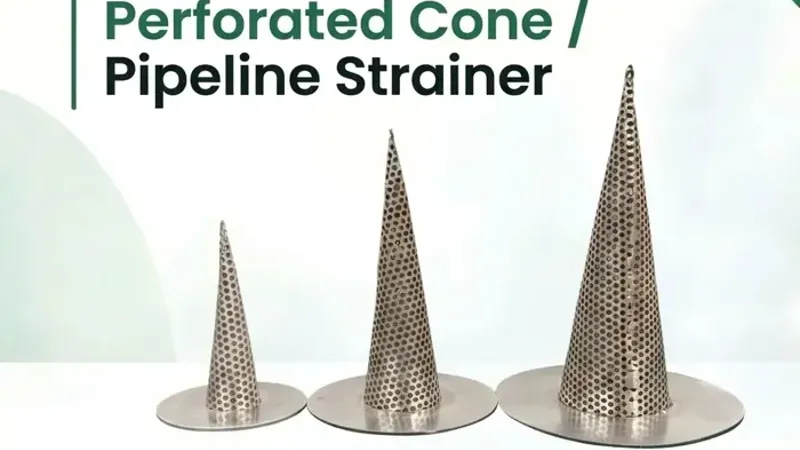
Perforated Cone / Pipeline Strainer
Introduction
During plant commissioning, equipment start-up, or routine process line operations, construction debris such as welding slag, pipe scale, gaskets, and metal shavings can easily travel down the pipeline and inflict catastrophic damage on pumps, turbines, flow meters, and control valves. The Perforated Cone / Pipeline Strainer (commonly referred to as a Witch’s Hat Strainer or Conical Strainer) supplied by FlowBiz Exports Pvt. Ltd. is an economical, reliable inline protection device. Engineered to fit directly between standard companion pipe flanges, this strainer captures particulate debris during initial fluid circulation or continuous processing without requiring additional valve housing space.
Product Overview
The Perforated Cone Pipeline Strainer consists of a conical-shaped element manufactured from perforated sheet metal, welded securely to a flat outer ring flange collar. The flat flange ring rests sandwiched between two companion line flanges, holding the perforated cone centered inside the pipe bore.
Key construction details verified on the product unit include:
- Conical Geometry: Tapered cone design that maximizes surface filtration area while maintaining a low overall pressure drop across the line.
- Flat Flange Collar: Outer mounting ring that matches standard ANSI, DIN, or BS flange face dimensions for effortless sandwich-style installation between existing pipe joints.
- Stainless Steel Metallurgy: Typically constructed from SS 304 or SS 316 stainless steel to ensure mechanical rigidity and chemical resistance under high velocity fluid flows.
- Versatile Orientations: Can be installed with the apex pointing upstream or downstream, depending on line velocity, expected solid accumulation, and cleanout accessibility.
Technical Specifications
Parameter | Specification |
Product Name | Perforated Cone / Pipeline Strainer |
Product Type | Conical Pipeline Strainer / Temporary Start-Up Strainer / Witch's Hat Strainer |
Nominal Size Range | DN25 to DN600 (1" to 24") [Customizable to match pipe schedules] |
Body Material | SS 304 / SS 316 Stainless Steel (Perforated Sheet / Wire Mesh) |
Perforation / Mesh Options | Standard 1/8" (3mm) or 1/16" (1.5mm) perforations; optional fine mesh lining |
Pressure Rating | Designed to fit between Class 150 / Class 300 / Class 600 / PN10 to PN40 Flanges |
End Connection | Wafer-style Flat Ring Collar (fits between Raised Face / Flat Face companion flanges) |
Operating Mechanism | Passive Inline Mechanical Filtration |
Operating Temperature Range | Cryogenic up to +400°C [Dependent on stainless steel material grade and pipe flange gasket selection] |
Flow Orientation | Bi-directional capability (Apex pointing upstream or downstream) |
Key Features
- Compact Flange-Mounted Design: Requires zero extra space along the piping layout, as the mounting ring slips directly into existing flanged pipe joints.
- High Open Area Ratio: Conical structure provides a high ratio of total open screen area compared to cross-sectional pipe area, preventing severe pressure drops.
- Cost-Effective Commissioning Protection: Offers an inexpensive defense mechanism for high-value equipment during new plant start-ups and flushing cycles.
- Durable Stainless Steel Construction: High structural integrity resists collapse under differential pressure buildup.
Working Principle / Operating Mechanism
- Flange Insertion: The conical strainer's outer flange ring is installed between two pipe flanges with standard gaskets on either side and bolted tightly.
- Inline Filtration: As process fluid flows through the pipe, solid particles larger than the sheet perforations are caught by the conical body.
- Debris Accumulation:
- Apex Pointing Upstream: Solid debris collects around the outer perimeter near the flange joint.
- Apex Pointing Downstream: Solid debris accumulates inside the center tip of the cone.
- Removal / Cleanout: After pre-commissioning flushing or when differential pressure rises, the pipe flange is unbolted, and the cone strainer is removed for cleaning or permanent removal.
Applications
- Plant Commissioning & Start-Up: Installed temporarily during line flushing to catch construction debris before starting compressors, turbines, or pumps.
- Oil & Gas Pipelines: Protecting meters, regulators, and pumps in natural gas and hydrocarbon headers.
- Chemical & Petrochemical Processing: Screening raw fluid transfers and protecting chemical metering pumps.
- Water Treatment & Power Plants: Inline filtration of cooling water, raw water feeds, and condensate systems.
- HVAC & District Utilities: Catching pipe scale and mill scale in large chilled/hot water distribution loops.
Benefits
- Prevents Severe Equipment Damage: Protects costly rotating machinery, turbine blades, and valve seats from destructive foreign solids.
- Extremely Economical: Significantly lower capital cost compared to fabricated basket strainer housing units.
- Simple Installation: Fits standard companion flanges without modifying existing pipework spool lengths.
- Reusable Element: Heavy-gauge stainless steel construction allows the cone to be washed, inspected, and reused across multiple start-up operations.
Material, Design and Configuration Options
- Material Grades: SS 304 for general utilities; SS 316 / 316L for corrosive chemicals, marine, and offshore duties.
- Mesh Lining: Plain perforated cone or dual-layer design with a fine wire mesh liner (e.g., 40, 60, 80, or 100 mesh) spot-welded inside or outside the cone.
- Handle / Tag Extension: Available with extended flange tabs or identification tags visible outside the flange joint to indicate strainer presence inside the line.
FlowBiz Exports — Product Supply and Enquiries
FlowBiz Exports Pvt. Ltd. is a leading supplier, manufacturer, and exporter of pipeline strainers and industrial flow accessories based in Ahmedabad, Gujarat, India. Serving major industrial zones including Ahmedabad, Vadodara, Surat, Dahej, Hazira, Vapi, Mumbai, Pune, as well as global export destinations, FlowBiz Exports delivers precision-engineered conical strainers manufactured to standard flange dimensions. For technical datasheets, custom perforation sizing, or commercial price quotes, reach out to the FlowBiz sales team through their website or enquiry portal.
Conclusion
The Perforated Cone / Pipeline Strainer is an essential, highly cost-effective component for protecting pipeline systems during flushing, start-up, and continuous operations. Its simple conical design, durable stainless steel structure, and easy flange-sandwich mounting ensure maximum protection with minimal pressure loss. Partnering with FlowBiz Exports Pvt. Ltd. guarantees quality-tested pipeline strainers built to exact industrial requirements.
Frequently Asked Questions (FAQs)
Q1: What is a Perforated Cone Pipeline Strainer?
It is a conical-shaped inline filter element made of perforated stainless steel that fits between pipe flanges to trap particulate debris, welding slag, and scale from flowing fluids.
Q2: Is a conical cone strainer temporary or permanent?
It can be used both as a temporary start-up strainer (removed after line commissioning and flushing) or as a permanent inline protection strainer in lower-debris applications.
Q3: Which direction should the cone apex point during installation?
It can be installed either way: pointing upstream (into the flow) to distribute debris around the outer edge, or pointing downstream (with the flow) to collect debris inside the center of the cone.
Q4: How is this strainer installed in a pipeline?
It features a flat outer ring collar that is sandwiched directly between two companion pipe flanges using standard flange gaskets and bolts.
Q5: How can I place an enquiry with FlowBiz Exports Pvt. Ltd. for cone strainers?
You can contact FlowBiz Exports Pvt. Ltd. by emailing info@flowbizexports.com, through their website [https://www.flowbizexports.com/](https://www.flowbizexports.com/), or by calling their customer service line with your specific pipe size, material grade, and pressure class requirements.
Technical Sources
- FlowBiz Exports Pvt. Ltd. Official Web Portal & Catalogue: https://www.flowbizexports.com/